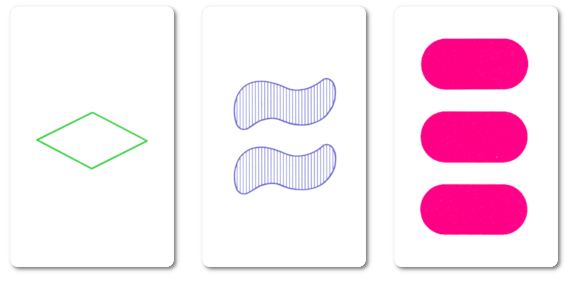
There’s a great game my brother showed me when I was in middle school called Set. It’s a really simple matching game where every card has four characteristics: a type of shape, a number of the shapes, a color, and the ‘filling’ of the shape. The goal was to create sets of three cards where each characteristic is either all the same or all different. You could have red red red, blue blue blue, green green green, or red blue green. All three could have a single shape, or you could have a one, a two, and a three, etc.
Thinking back to the last post I made about class role design, we have a general role for a class to fill in the gap on the pyramid – an equally skill-and-magic class with less focus on combat – but that’s sort of it. So why bring up Set?

Because if you’re like me, you have a part of your brain that eternally craves balance in all things. And Set is a game entirely about that balance.
NEGATIVE SPACE
The idea of negative space is basically to observe the empty bits between stuff. The gap between objects is itself a “thing” if you look at it. There’s plenty of pieces of art and optical illusions you can use as examples.

So rather than looking at what class roles are missing, this time we’ll be looking at which flavors of each role already exist and how each role gets presented. That way, it will be easier to find a unique niche for the new class. Specifically, if magic is going to play a major part of a class, the tradition of the magic needs special attention, and there’s the matter of casting stat and if they’re prepared or spontaneous.
Right now, the current class spread is as follows:
– Arcane: Wizard (Int, prepared), Magus (Int, prepared, bounded)
– Divine: Cleric (Wis, prepared), Champion (Cha, focus only), Oracle (Cha, spontaneous), Monk* (Wis, focus only)
– Occult: Bard (Cha, spontaneous), Monk (Wis, focus only), Psychic* (Int or Cha, spontaneous)
– Primal: Druid (Wis, prepared), Ranger* (Wis, focus only)
– Any: Sorcerer (Cha, spontaneous), Witch (Int, prepared), Summoner (Cha, spontaneous, bounded)
Note: I’m not including Eldritch Trickster Rogue because 1. only one racket gets that and 2. it just uses the archetype rules anyway.
Also, Ranger and Monk only kind of count, as both are opt-in caster. Monk is especially hard to categorize as it chooses between divine and occult. Champion at least always has some divine stuff built in.
Lastly, Psychic is considered a full caster, though it gets fewer spells than any other one and is largely cantrip based.
I did a lot of this sort of data analysis in college, so bare with me. The final score is:
– Tradition: 3* divine, 2 occult, 2 arcane, 2* primal, and 4* of variable tradition
– Stats: 3.5 Int, 5** Wis, 5.5* Cha
– Style: 5 prepared, 5 spontaneous, 3 focus-only
– Slot-wise: 8 full 9-ranks, 2 bounded, 3 focus-only
*counting the focus spell classes
Keeping in mind that focus spell classes only sorta count here, these measurements alone mean the most missing combination is either an Int or Wis caster, likely primal tradition, with bounded spellcasting. It could be either prepared or spontaneous.
SO… WHAT DOES THAT MEAN
Would that be a solid class? Could be. But that’s only part of the big picture. If the next class were a prepared primal Wisdom-based bounded spellcaster… it would be the “druid but bounded” class. There isn’t an Int primal caster yet, but thematically speaking an Int primal caster is kinda weird, and even then it’s just “Int Druid” at that point. If it were spontaneous it would just add “but spontaneous” to it, and so on. The class would need some big pull to distinguish itself.

At the same time, you have to look at the trappings in the design. As mentioned, Int-primal is a little incongruous. Traditionally (heh) Int is for Arcane and Occult, Wis is for Divine and Primal, and Cha can fit all four. And as of right now, there are no prepared Cha classes of any tradition, and also no spontaneous Wis classes. Not to say you can’t make a class that breaks that tradition – especially if it’s based on a pretty small sample size – but unless you have a good reason to break a rule or guideline, it’s usually better design to not do so.
Put simply, things aren’t equally spread; both arcane classes are prepared, both full occult classes are spontaneous, every pure-primal class (the only one) is prepared wisdom. So let’s look at the list with more perspective. The rarest of each category:
– Int is the rarest stat with only 3.5 classes, but 2.5 are full 9-slots and the other is bounded. The rarest slot-casters stat is Wis with only 2, both being prepared.
– Primal is the rarest, with 1 out of 7 slot-casters (excluding variables) and 1 focus-only.
– Bounded only has 2 out of the 10 full-casters, neither of which are Wis based.
– Variable-tradition classes make up 1 out of 4 casters, none of which are Wis based.
– Focus-only classes are only 3 out of 13 classes with spells, none of which are Int based or Arcane.
With this in mind, there are three actual ‘rarest’ spellcasting features based on combinations.
– First by far is being Wis based full-casting. Multiple other features have no Wis representation. No spontaneous, no variable tradition, no bounded.
– Second, classes that only have focus spells and are primarily martial or skill based only existing in Champion and some Rangers and Monks. There’s no such class that uses Int, and there’s no such class with the Arcane tradition.
– Finally, with the exception of half of Psychics, all spontaneous classes are Cha based (and zero Wis based), and excluding the variable traditions, there’s no spontaneous primal casters (or bounded, but without Summoner that’s literally only Magus).
Now, if we’re talking about designing a new class to fill these gaps, a spontaneous Wis based bounded Primal caster would be the most un-explored in the game right now. But I can’t really see myself doing that… again. My version of the updated Kineticist is literally all these things: it’s a spontaneous bounded Wis Primal caster, and it’s also kind of a focus spell class in that all the big blasts are focus spells. I decided to update Kineticist originally because it was one of my favorite classes in 1e, but the way I designed it was at least in part because those features were less common.
While that’s my own project, I’m going to consider it in this spread of classes for the sake of making another one since whatever hypothetical class comes out of this would also be my own project. With that said, other combinations worth considering:
- An Int-based focus spell only class.
- An Arcane (maybe Occult) focus-only class.
- A non-Arcane bounded caster.
- A spontaneous Arcane or Primal caster.
- A prepared Occult caster.
- A Cha-based Arcane or Primal class.
- An (only) Int-based Occult class.
- A non-Cha-based spontaneous caster.
That’s a lot of room to work with. In addition to a spontaneous Primal caster, there’s a wide opening for a spontaneous Arcane caster or prepared Occult caster. Likewise, stat-wise things are locked down, with Primal only having Wis, Arcane only having Int, and Occult having only half a class that isn’t Cha. Mix in bounded or focus-only classes, and whatever class fills this gap could wind up very unique.
NEXT TIME…

We have a playtest coming up revealing new classes. Will either of them fill these gaps I pointed out? I have shown people at Paizo the class pyramid and explained the open area a while back – specifically suggesting a skilled-mage that uses luck-magic – so it’s possible that idea took root. Or will they both be something completely out of left field, like a skill-based tanking class with a bunch of debuff-abilities (another thing I’ve drafted up)? We’ll have to wait and see.
Other Posts
- Game, Set, MatchWhen you think of a new class idea, it isn’t enough to just think of what doesn’t exist yet and throw it all together. You need to look at the big picture and the balance of everything involved.
- Filling in the BlanksI went over a method you can use to “mathematically” categorize a character concept or class. However, the class pyramid isn’t limited to this use. It can be a very versatile tool if you know how to use it.
- Make Love, Not WarlockLast in our trio of pseudo-warlocks uses the Psychic class. While there’s no exact copy of eldritch blast, Psychics are the superstars of cantrips and adding bonus effects on your spells.
 Andrew D. Geels